 +91 988 988 5040
 care@nexivf.in
When a couple struggles to conceive, one of the most important factors to examine is the health of the woman’s fallopian tubes. These tiny, delicate tubes play a crucial role in natural conception. Even a partial or complete blockage can prevent pregnancy — but the good news is, with the right diagnosis and treatment, many women can still achieve motherhood.
At Nex IVF and Fertility Centre, we help women understand their reproductive health deeply, ensuring clarity, confidence, and the right treatment approach.
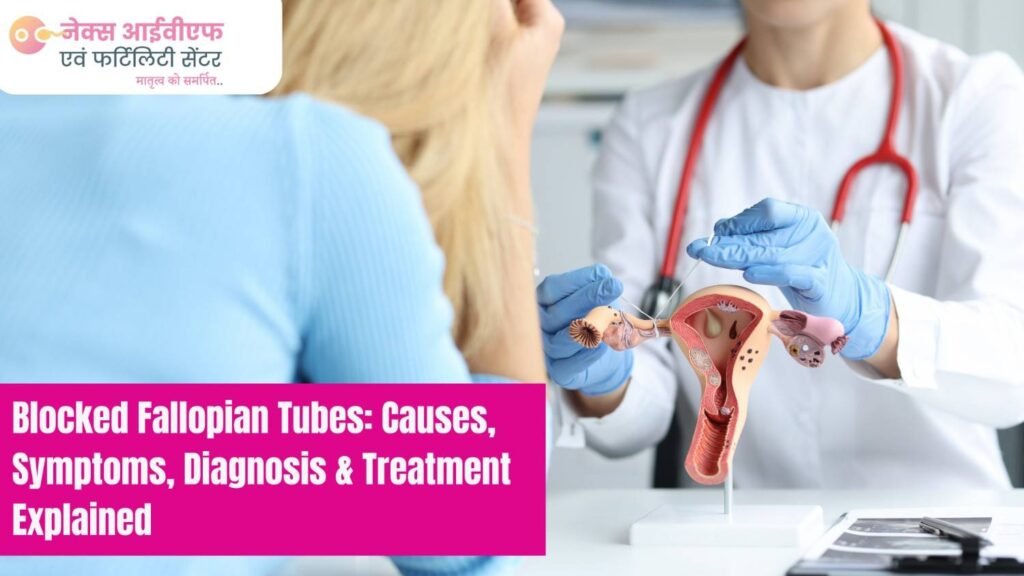
🧬 Understanding the Role of Fallopian Tubes in Fertility
Fallopian tubes act as a bridge between the ovaries and the uterus. They are responsible for:
- Picking up the released egg
- Providing a space for sperm and egg to meet
- Supporting early embryo movement into the uterus
If one or both tubes are blocked, these steps cannot occur naturally, leading to infertility or delayed conception.
⚠️ What Causes Fallopian Tube Blockage?
Several medical conditions and infections can damage or block the tubes:
- Pelvic Inflammatory Disease (PID)
- Sexually transmitted infections (like chlamydia or gonorrhea)
- Endometriosis
- Previous ectopic pregnancy
- Uterine or abdominal surgeries
- Fibroids near the fallopian tubes
- Tubal scarring from infections
In many cases, the blockage develops silently without noticeable symptoms.
🔍 Signs and Symptoms of Fallopian Tube Blockage
Most women do not experience obvious symptoms, which is why testing becomes important.
However, some may notice:
- Difficulty conceiving
- Pelvic or lower abdominal pain
- Painful periods
- Pain during intercourse
- History of pelvic infections
If these signs are present, early evaluation is essential.
🧪 How Is Fallopian Tube Blockage Diagnosed?
Several diagnostic tests can identify tubal health:
1. HSG (Hysterosalpingography)
A dye-based X-ray that shows whether tubes are open or blocked.
2. HyCoSy / SSG
An ultrasound-based method using saline to evaluate tubal patency.
3. Laparoscopy
A minimally invasive procedure to visually inspect and sometimes repair tubes.
4. Sonosalpingography
Used to assess tubal movement and fluid passage.
Early detection helps guide the right treatment plan.
🩺 Treatment Options for Blocked Fallopian Tubes
Treatment depends on the severity and location of the blockage:
1. Medication & Infection Management
For blockages caused by infections or inflammation.
2. Laparoscopic Surgery
To remove adhesions, scar tissue, or endometriosis.
3. Tubal Recanalization
A procedure to open tubes blocked near the uterus.
4. IVF (In Vitro Fertilization)
If tubes are severely damaged or both tubes are blocked, IVF becomes the most effective path to pregnancy.
It bypasses the tubes entirely by fertilizing the egg in the lab.
🌱 Can You Get Pregnant With Blocked Fallopian Tubes?
Yes — depending on the condition:
- One tube open: Natural conception is still possible.
- Both tubes blocked: IVF offers excellent success since tubes are not needed for fertilization.
- Hydrosalpinx (fluid-filled tubes): Removing or treating the affected tube improves IVF success.
Every case is unique, and a fertility expert can guide the best approach.
👨⚕️ How Nex IVF and Fertility Centre Supports You
At Nex IVF, we provide comprehensive and compassionate care through:
- Advanced diagnostic imaging
- Expert evaluation of tubal health
- Personalized treatment plans
- Minimally invasive surgical options
- High-success IVF protocols
- Emotional and medical support throughout your journey
Your fertility journey deserves the best guidance, clarity, and care.
💬 Final Words
A fallopian tube blockage can be emotionally overwhelming, but it does not mean the end of your dream of becoming a mother. With early diagnosis and the right treatment, many women successfully conceive — naturally or through IVF.