 +91 988 988 5040
 care@nexivf.in

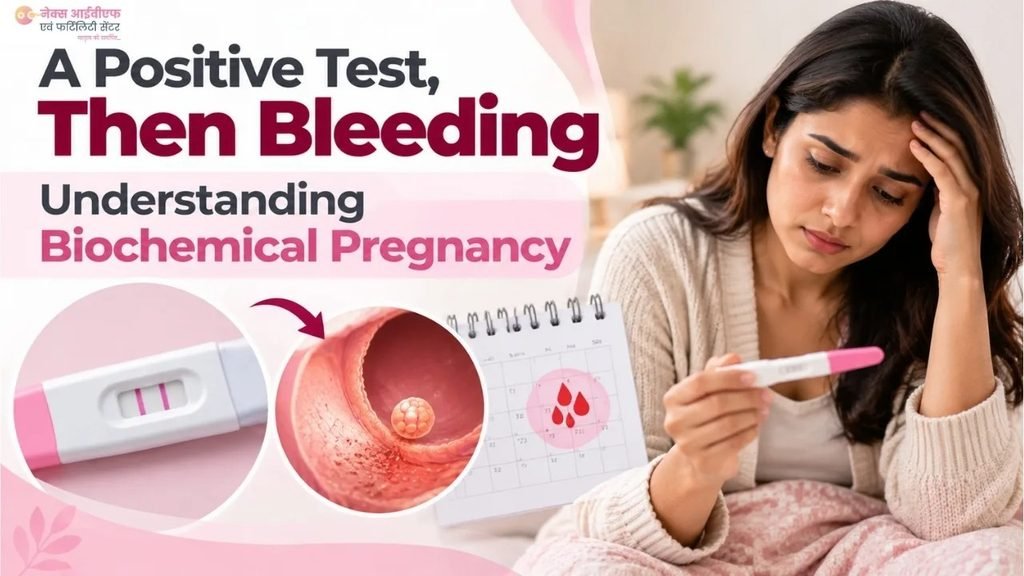
A positive pregnancy test can bring hope. If bleeding starts soon afterwards or a later test becomes negative, it may be confusing and painful. This early loss is sometimes called a biochemical pregnancy or chemical pregnancy.
At NEX IVF and Fertility Centre, your fertility team can explain the results of your pregnancy tests and advise you about follow-up after IVF.
What Is a Biochemical Pregnancy?
It is a pregnancy detected by hCG in blood or urine that ends before a pregnancy can be confirmed on ultrasound. It is a real pregnancy loss, even though no gestational sac was seen. “Chemical pregnancy” and “biochemical pregnancy” describe the same situation. There is no fixed hCG number that by itself proves this diagnosis.
What Signs Might You Notice?
You might have a positive home or clinic test, followed by spotting or bleeding around the time of a period. A repeat test may become negative. Cramps may occur, but some people notice no symptoms at all. Bleeding after a positive test does not always mean a biochemical pregnancy: an ongoing pregnancy or an ectopic pregnancy may also need assessment.
How Do Doctors Check What Happened?
Your clinician may repeat a quantitative blood hCG test to see how the level changes. An ultrasound may be useful at the right stage, but a very early scan may show no pregnancy even when a test is positive. One hCG reading, or a rule that hCG must double at a precise rate, cannot reliably establish the outcome or location of every pregnancy.
Follow the testing plan your clinician gives you. When a pregnancy location has not been confirmed, follow-up is important until the team can safely explain the result and rule out an ectopic pregnancy.
Why Can This Happen?
Many early losses involve an embryo that cannot continue developing, often because of a chromosomal problem. Age and certain medical conditions may also matter, but in most individual cases there is no single cause that can be proven. A biochemical pregnancy does not mean you exercised, felt anxious or ate the wrong food. A single event is usually not a reason to assume you have a problem with your uterus, hormones or sperm DNA.
Does It Mean IVF Has Failed Permanently?
No. IVF clinics detect very early pregnancies more often because they schedule pregnancy tests after embryo transfer. A biochemical pregnancy shows that hCG was produced, but it does not predict that a later cycle will succeed or fail. Your specialist will review your age, embryo and treatment history alongside any other relevant findings. Extra tests or a different IVF approach are considered according to your circumstances, particularly if losses recur.
What Happens Next?
Many biochemical pregnancies resolve without a procedure, but a follow-up plan still matters. Your clinician may check that hCG is declining and assess symptoms. Do not stop progesterone or other prescribed IVF medicines after a home test or bleeding without speaking to your team. Ask when it is reasonable for you to try again; there is no universal requirement to wait exactly one menstrual cycle.
When Should You Seek Urgent Help?
Get urgent medical assessment for severe or one-sided abdominal pain, shoulder-tip pain, fainting, dizziness or heavy bleeding. These can be warning signs of an ectopic pregnancy or significant blood loss. Contact your fertility team for any bleeding after a positive IVF test, even when it seems light.
Can Another Pregnancy Happen?
Yes. One biochemical pregnancy usually does not mean you cannot have a healthy pregnancy in the future. If you have repeated losses or other fertility concerns, ask your specialist what evaluation may be useful. Take time to recover emotionally as well as physically: an early loss can still feel profound.
Final Words
A biochemical pregnancy is an early pregnancy loss detected by a test before confirmation on ultrasound. Repeat testing and individual follow-up help clarify what happened and protect your health.
Medical note: This article is general education. Bleeding or pain after a positive pregnancy test requires advice from your treating team; seek urgent care for the warning signs above.
Evidence consulted: ACOG, Early Pregnancy Loss; NHS, Ectopic pregnancy.