 +91 988 988 5040
 care@nexivf.in
Embryo transfer is one of the most important steps in the IVF journey. If you’re undergoing treatment, you may come across two options—fresh embryo transfer and frozen embryo transfer (FET). Understanding the difference between these approaches can help you make informed decisions about your fertility plan.
At Nex IVF and Fertility Centre, specialists guide patients in choosing the most suitable option based on their individual health and treatment goals.
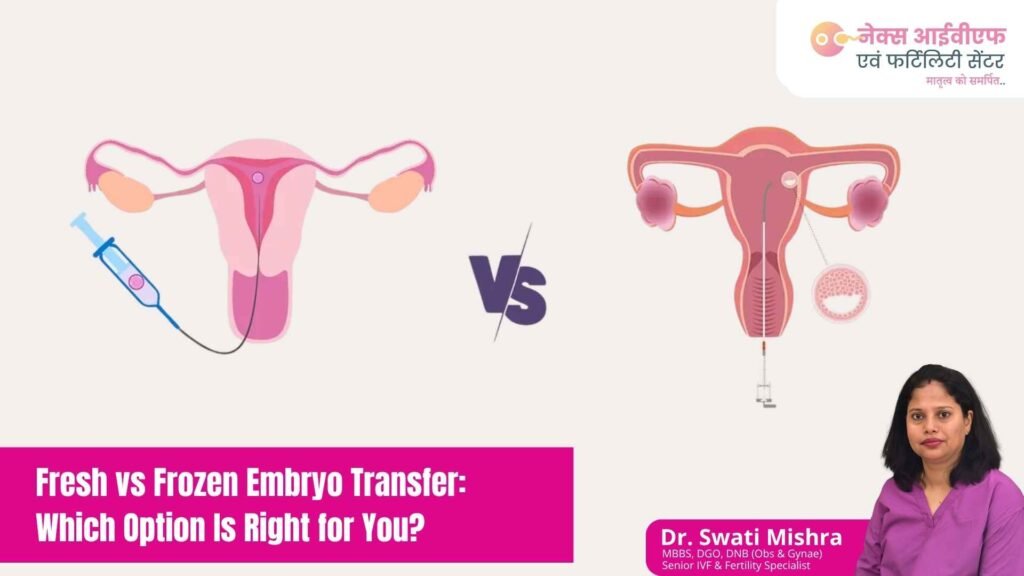
What Is a Fresh Embryo Transfer?
In a fresh embryo transfer, the embryo is transferred into the uterus within the same cycle in which eggs are retrieved and fertilized.
How It Works:
- Ovarian stimulation and egg retrieval
- Fertilization in the lab
- Embryo development (usually 3–5 days)
- Immediate transfer into the uterus
Advantages:
- Shorter overall treatment timeline
- No need for freezing and thawing
- Faster progression from retrieval to transfer
What Is a Frozen Embryo Transfer (FET)?
In a frozen embryo transfer, embryos are frozen after fertilization and transferred in a later cycle.
How It Works:
- Embryos are created and frozen (vitrification)
- The uterus is prepared in a future cycle
- Embryos are thawed and transferred
Advantages:
- Better uterine preparation
- Reduced risk of ovarian hyperstimulation
- Higher flexibility in timing
- Often improved implantation rates in certain cases
Key Differences Between Fresh and Frozen Transfer
| Feature | Fresh Embryo Transfer | Frozen Embryo Transfer |
|---|---|---|
| Timing | Same cycle as egg retrieval | Later cycle |
| Uterine Environment | Influenced by stimulation hormones | More natural and controlled |
| Flexibility | Limited | High |
| Risk of OHSS | Slightly higher | Lower |
| Success Rate | Good | Often equal or higher in many cases |
Which Option Is Better?
There is no one-size-fits-all answer. The best option depends on several factors:
- Age and overall health
- Hormonal response during stimulation
- Uterine condition
- Risk of OHSS
- Previous IVF outcomes
At Nex IVF and Fertility Centre, a personalized approach ensures that the most suitable method is selected for each patient.
When Is Frozen Transfer Recommended?
Doctors may suggest FET if:
- Hormone levels are not ideal for immediate transfer
- There is a risk of ovarian hyperstimulation
- Genetic testing (PGT) is planned
- The uterine lining needs better preparation
Success Rates: Fresh vs Frozen
Recent studies show that frozen embryo transfer often has comparable or even higher success rates in certain cases due to improved uterine conditions.
However, outcomes vary based on individual health factors.
Emotional and Practical Considerations
- Fresh transfer: Faster but may feel rushed
- Frozen transfer: Requires patience but allows better preparation
Understanding your comfort level and expectations is important.
Role of Advanced Technology
Modern freezing techniques like vitrification ensure high survival rates of embryos after thawing, making frozen transfers highly effective.
At Nex IVF and Fertility Centre, advanced lab technology ensures optimal embryo preservation and transfer success.
Final Words
Both fresh and frozen embryo transfers are effective options in IVF treatment. The right choice depends on your medical condition, treatment response, and overall fertility plan.
With expert guidance and personalized care, you can choose the option that offers the best chance of success.