 +91 988 988 5040
 care@nexivf.in

IVF treatment often raises questions about injections, medication and side effects. If you have heard of mild IVF, you may wonder whether using less medicine would make treatment easier and still give you a good chance of pregnancy.
Mild IVF can be a suitable option for some people, but the right stimulation plan depends on your age, ovarian reserve, fertility history and goals. At NEX IVF and Fertility Centre, a fertility specialist can explain what each approach may mean for your treatment.
What Is Mild IVF?
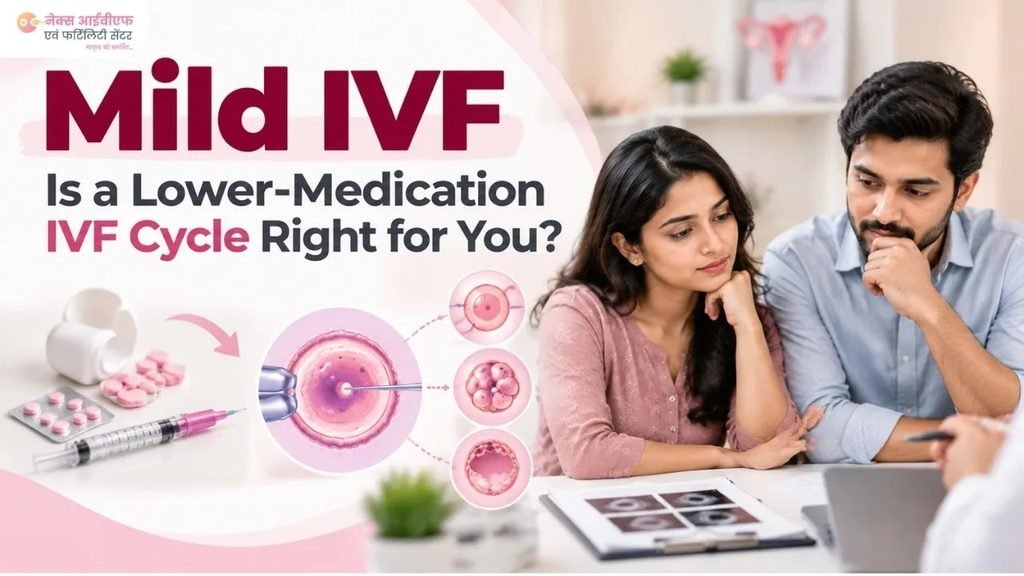
Mild IVF, also called minimal stimulation IVF, uses lower doses of medication to encourage the ovaries to develop follicles. A treatment plan may include lower-dose hormone injections, oral medicines or both.
The aim is generally to collect fewer eggs than in a conventional IVF cycle. The remaining steps are familiar: the eggs are retrieved, fertilised in the laboratory, and any suitable embryos may be transferred or frozen.
Mild IVF is different from natural-cycle IVF, which uses little or no medication to stimulate the ovaries.
What Happens During a Mild IVF Cycle?
Your fertility team first chooses a medication plan based on your test results and medical history. During stimulation, ultrasound scans – and sometimes blood tests – help the team monitor follicle growth.
When the follicles are ready, you may receive a trigger medicine before egg retrieval. The collected eggs are then fertilised with sperm in the laboratory. Your specialist will discuss embryo transfer or freezing according to your results and treatment plan.
Mild IVF does not guarantee a cycle without injections. The number of doses and treatment days varies from person to person.
Mild IVF and Conventional IVF: What Is the Difference?
Stimulation medicines: Mild IVF generally uses lower doses. Conventional IVF uses a dose chosen to encourage an appropriate follicle response.
Eggs collected: Mild IVF usually results in fewer eggs. Conventional IVF may produce more, depending on the ovarian response.
Embryos available: A mild cycle may leave fewer for transfer or freezing. Collecting more eggs may provide more opportunities to develop embryos.
Costs: Mild IVF may reduce medication costs, but the overall cost can rise if another retrieval is needed. The total for either plan depends on the treatment proposed.
Neither approach guarantees a particular number of eggs or embryos. Using less medication also does not automatically improve egg quality.
Who Might Consider Mild IVF?
A specialist may discuss mild stimulation if you are expected to produce only a small number of eggs despite larger medication doses. It may also appeal to someone who prefers a lower-medication approach and understands that fewer eggs may be collected.
If you have PCOS or are expected to respond strongly to stimulation, preventing ovarian hyperstimulation syndrome (OHSS) is an important part of planning. Your specialist should consider the whole safety strategy rather than assume mild IVF is the only suitable option.
What Are the Possible Benefits?
For some patients, taking less stimulation medicine may make the cycle easier to manage. Medication costs may also be lower.
These benefits need to be considered alongside the results you are likely to get. A lower-dose cycle may produce fewer embryos for future transfers. If you need another egg retrieval, the total time and cost of treatment may increase.
Does Mild IVF Have the Same Success Rate?
There is no success rate that applies to everyone choosing mild IVF. Age, the cause of infertility, ovarian response, sperm health and embryo development all influence the outcome.
For people expected to respond poorly to stimulation, mild IVF may be worth considering because increasing medication does not always produce a better result. For others, collecting more eggs in a conventional cycle may offer more opportunities for embryo transfer.
When discussing success figures with a clinic, ask whether the number refers to a positive pregnancy test or a live birth. Also ask whether it counts one embryo transfer or all transfers possible from one egg retrieval.
Questions to Ask Your Fertility Specialist
- How do you expect my ovaries to respond?
- Why are you recommending this medication dose?
- How might collecting fewer eggs affect future embryo transfers?
- What is my plan for reducing OHSS risk?
- What would the total cost be if I needed another retrieval cycle?
Final Words
Mild IVF offers a lower-medication approach to ovarian stimulation, but it is not automatically quicker, safer or more successful than conventional IVF. The most useful choice is the one made after reviewing your likely response, safety needs and family-planning goals.
Medical note: This article is for general education. Start or change fertility medicines only under the guidance of your treating specialist.